02 / 16
LED Blink: HIGH, LOW & Delay
Run an Arduino LED blink experiment. Compare 500 ms and 1000 ms delays, follow D13, and calculate the full on-off cycle.
Run this experiment →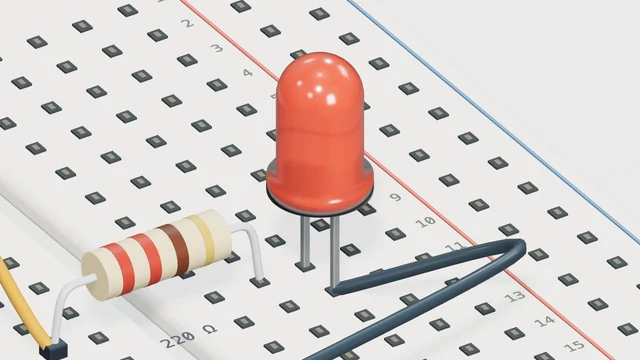
Why it’s here
Use HIGH, LOW and a delay to set a rhythm.
How it works
A delay pauses this example before the next change. On-time plus off-time is one cycle. A 1000 ms on-time and a 500 ms off-time gives a 1.5 second cycle. The external LED needs a series resistor.
Try it
- Open this experiment
- Run with 500 ms on and 500 ms off. Change only the on-time to 1000 ms and count the duration of a full cycle.
Connections
- D13 — Resistor → LED +
- GND — LED −
Example sketch
void setup() {
  pinMode(13, OUTPUT);
}

void loop() {
  digitalWrite(13, HIGH);
  delay(500);
  digitalWrite(13, LOW);
  delay(500);
}
Check your understanding
With 1000 ms on and 500 ms off, how long is one cycle?
Show the answer
1500 ms. A cycle includes both the illuminated phase and the dark phase; the on-time alone is not the period.