ESP32 vs Arduino Uno: Which Board Should You Learn First?
Both the Arduino Uno and the ESP32 can blink an LED, read a sensor, and drive a servo, yet they make very different tradeoffs in logic voltage, wireless networking, and pin behavior. Comparing the two boards side by side helps you pick the right starting point before buying hardware.
Explore Learn ESP32 & its website →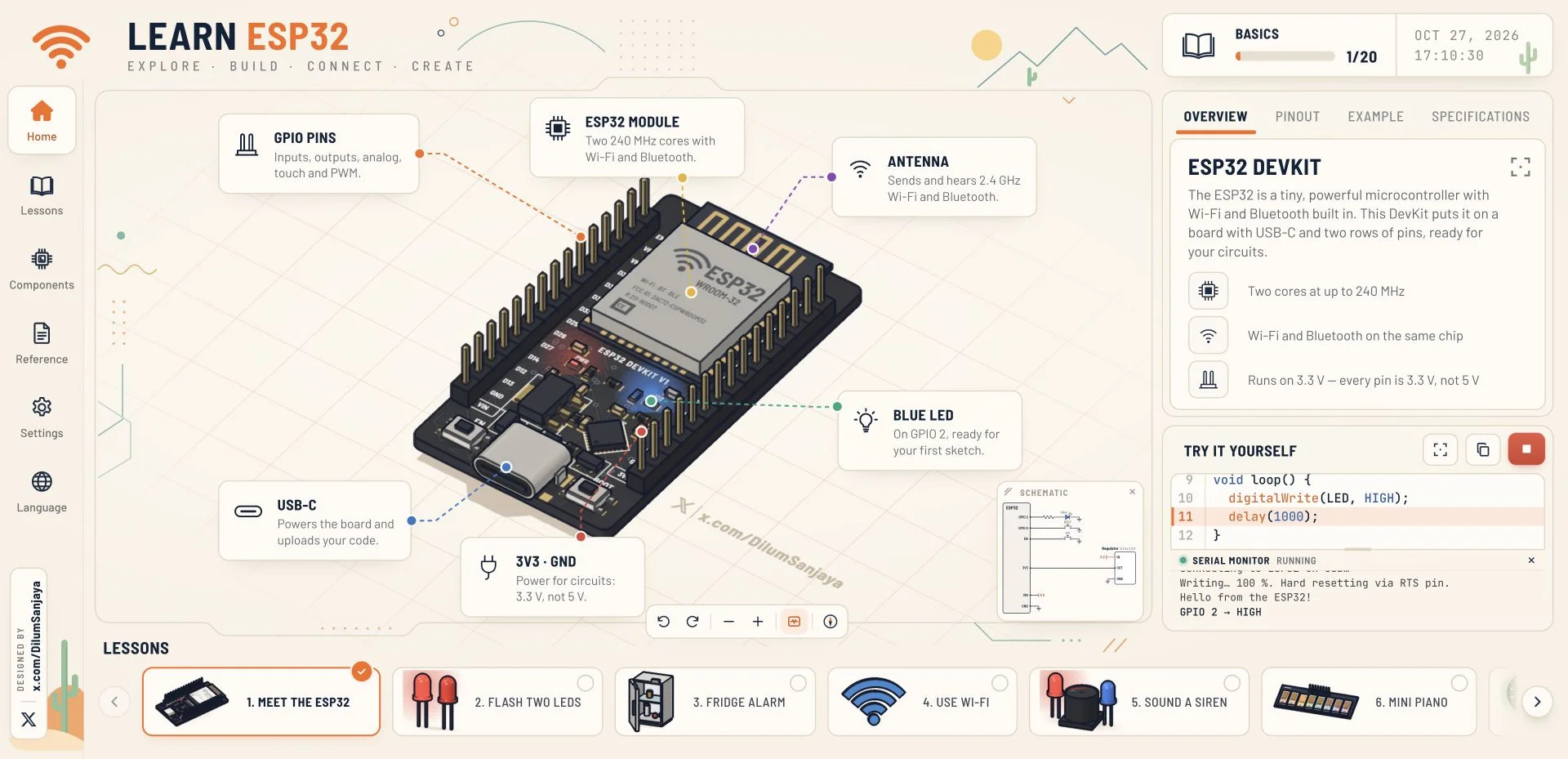
Specifications reflect the classic Arduino Uno R3 (ATmega328P) and standard ESP32-WROOM-32 DevKit boards, paired with interactive circuit lessons in NavSprout’s Learn Arduino and Learn ESP32 workbenches.
Core hardware differences at a glance
The biggest practical divide between an Arduino Uno and an ESP32 is not clock speed—it is logic voltage and built-in connectivity. The classic Arduino Uno runs at 5 V logic, tolerates higher per-pin current, and has a simple pin map that is hard to misconfigure. The ESP32 runs at 3.3 V logic, includes Wi-Fi and Bluetooth on the chip, and packs far more RAM and processing power, but requires more care with strapping pins and 5 V sensors.
| Feature | Arduino Uno (ATmega328P) | ESP32 (ESP32-WROOM-32) |
|---|---|---|
| Logic voltage | 5 V (5 V tolerant GPIO) | 3.3 V (not 5 V tolerant without level shifting) |
| Wireless radios | None built in (requires shields/modules) | Built-in 2.4 GHz Wi-Fi and Bluetooth / BLE |
| Clock & cores | 16 MHz single-core 8-bit AVR | Up to 240 MHz dual-core 32-bit Xtensa |
| Flash / SRAM | 32 KB flash / 2 KB SRAM | 4 MB flash / ~520 KB SRAM |
| Analog inputs (ADC) | 6 channels, 10-bit (0–1023) | Up to 18 channels, 12-bit (0–4095) |
| Best first projects | Buttons, LEDs, servos, breadboard fundamentals | Wi-Fi sensors, ESP-NOW links, web dashboards |
Why 5 V vs 3.3 V matters on a breadboard
Many beginner sensor kits ship with 5 V ultrasonic modules, relay boards, and character LCDs designed around the Arduino Uno. Connecting a 5 V output signal directly to an ESP32 GPIO pin can stress or permanently damage the ESP32 input stage. Conversely, modern I2C sensors (barometers, IMUs, OLED displays) are native 3.3 V parts that plug straight into an ESP32 without a level shifter.
Before wiring any external module, check its VCC range and its logic-high voltage separately. A module powered from 5 V can still output a 5 V digital signal that needs a resistive voltage divider or logic level converter before reaching a 3.3 V microcontroller.
Test both boards in the browser first
- Open the Learn Arduino workbench and run the Blink and Knob lessons to see 5 V digital outputs and 10-bit analog readings.
- Open the Learn ESP32 workbench and inspect the board pinout and Wi-Fi lesson to see how wireless connectivity changes project architecture.
- Compare how each sketch sets pin modes and reads sensor values—both use the same Arduino C++ setup() and loop() structure.
- Pick Arduino Uno if your first goal is pure circuit fundamentals with 5 V kits; pick ESP32 if you want Wi-Fi telemetry, smart-home triggers, or wireless nodes right away.
Common beginner mistakes when moving to ESP32
Developers moving from Arduino Uno to ESP32 often stumble on three details: boot strapping pins (such as GPIO 0, 2, 12, and 15) that can prevent flashing if pulled the wrong way at reset; ADC2 pins that cannot be read reliably while Wi-Fi is active; and input-only pins (GPIO 34–39) that lack internal pull-up resistors.
Keeping a clean pin-assignment table for your project—reserving ADC1 pins for analog sensors and avoiding strapping pins for heavy loads—prevents most early headaches.
Common questions
Can I program an ESP32 using the Arduino IDE?
Yes. Installing the official Espressif ESP32 board package lets you write setup() and loop() sketches in the Arduino IDE using familiar digitalWrite() and analogRead() functions.
Is Arduino Uno obsolete now that ESP32 is cheaper?
No. For classroom electronics, 5 V legacy sensor kits, and predictable low-complexity timing, the Arduino Uno remains one of the most forgiving learning boards available.
Which board uses less power on batteries?
In active Wi-Fi mode the ESP32 draws far more peak current (150–240 mA) than an Uno, but in deep sleep an ESP32 can drop to tens of microamps, making it much better for periodic wireless sensing when properly configured.
Sources & editorial method
Written by NavSprout Editorial. Published and checked .
- NavSprout Learn ESP32 Interactive Workbench ↗
- NavSprout Learn Arduino Interactive Workbench ↗
- Espressif ESP32 Technical Reference Manual ↗