ESP32 Wi-Fi vs ESP-NOW: Practical Wireless Lab Guide
Every ESP32 ships with a 2.4 GHz radio, but connecting to a home router over full Wi-Fi is not always the best way to move a 12-byte sensor reading. Understanding the tradeoff between Wi-Fi and Espressif’s connectionless ESP-NOW protocol helps you build faster, lower-power wireless nodes.
Explore Learn ESP32 & its website →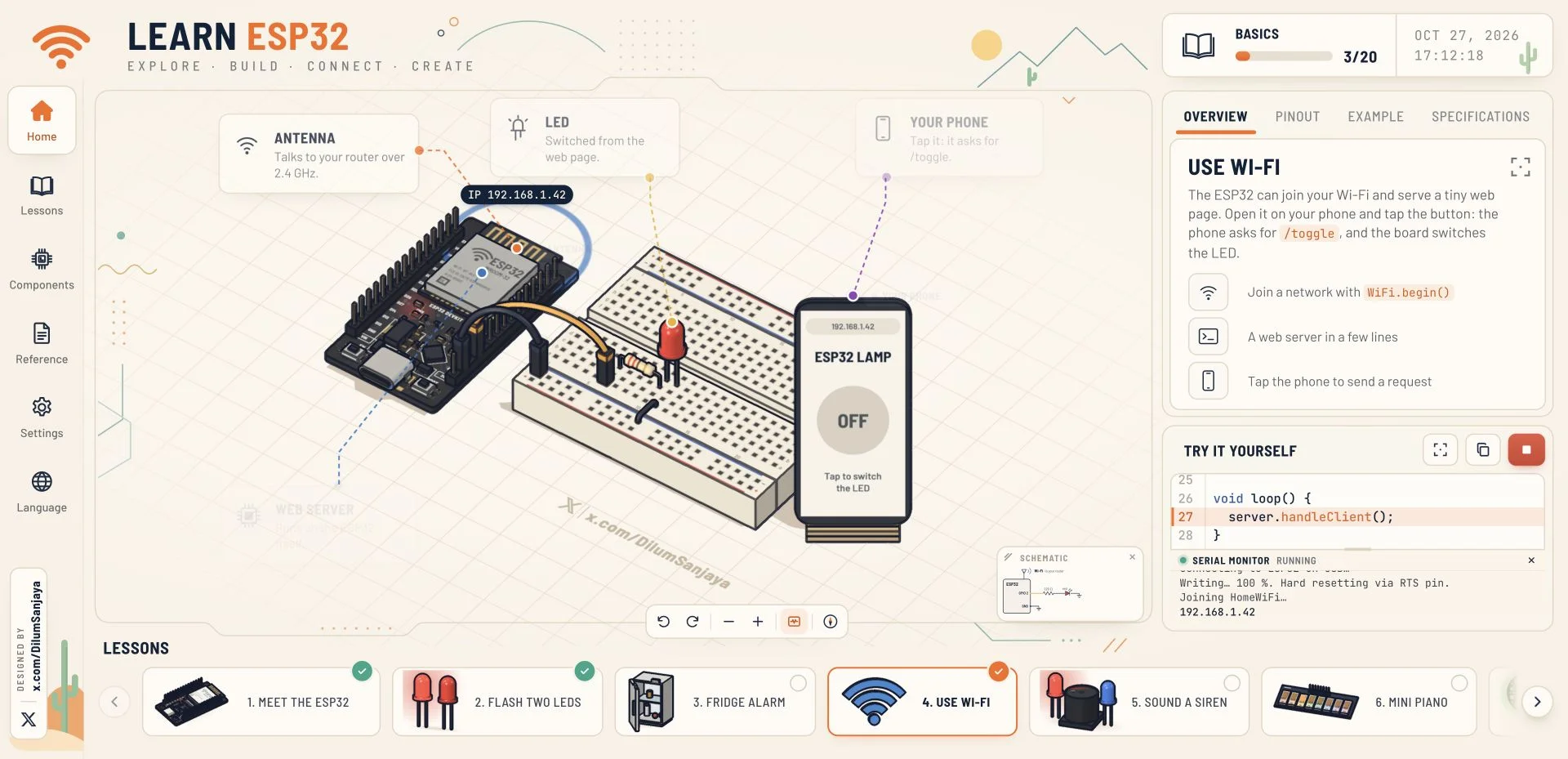
Protocol limits and architecture notes are based on Espressif’s ESP-IDF Wi-Fi and ESP-NOW specifications alongside NavSprout’s interactive Learn ESP32 wireless lessons.
Wi-Fi vs ESP-NOW: side-by-side tradeoffs
Standard Wi-Fi gives an ESP32 an IP address via DHCP and full access to DNS, HTTPS APIs, MQTT brokers, and local web browsers. That convenience costs association time (often 1–4 seconds after waking from deep sleep) and higher battery drain. ESP-NOW skips the router and IP stack completely, sending small encrypted packets directly between ESP32 MAC addresses in milliseconds.
| Dimension | Standard Wi-Fi (STA / AP) | ESP-NOW (Peer-to-Peer) |
|---|---|---|
| Router required? | Yes in STA mode (or phone connects to AP) | No — direct board-to-board frames |
| Wake-to-send latency | Typically 1,000–4,000 ms (DHCP + TCP) | Typically under 50–150 ms |
| Max payload per packet | Streamed via TCP/HTTP (megabytes) | 250 bytes per frame |
| Internet / browser access | Direct HTTP, HTTPS, WebSockets, MQTT | None directly (needs a Wi-Fi gateway node) |
| Typical use case | Web dashboards, cloud telemetry, OTA updates | Battery door sensors, remote switches, multi-node relays |
Walk through both wireless lessons in the browser
- Open the Learn ESP32 Wi-Fi lesson to trace how the board connects to an access point and serves status data over the local network.
- Open the Learn ESP32 ESP-NOW lesson to see how a sender node transmits a compact struct directly to a peer MAC address without an IP router.
- Note how the two patterns combine in real deployments: battery-powered leaf nodes send 20-byte readings via ESP-NOW to a single wall-powered ESP32 gateway that forwards them over Wi-Fi.
Channel matching and payload packing tips
When pairing ESP-NOW nodes, both boards must operate on the same 2.4 GHz Wi-Fi channel. If your gateway board also connects to a home router over Wi-Fi, the router controls the channel—meaning your leaf nodes should either lock to that channel or scan channels until an ESP-NOW delivery callback succeeds.
Keep ESP-NOW payloads inside a fixed-size C struct with explicit integer widths (uint16_t, int32_t) rather than variable-length strings. That keeps packets well under the 250-byte ceiling and avoids parsing bugs across firmware builds.
Common questions
Can ESP-NOW encrypt messages between two ESP32 boards?
Yes. ESP-NOW supports CCMP encryption using a Primary Master Key (PMK) and Local Master Key (LMK), though encrypted peer counts are lower than unencrypted peers.
How far does ESP-NOW reach compared to normal Wi-Fi?
With clear line of sight outdoors, ESP-NOW frequently reaches 100–200 meters (and further in Long Range mode), often slightly outperforming standard Wi-Fi because it avoids router handshake overhead.
Can an ESP32 run Wi-Fi and ESP-NOW at the same time?
Yes, by configuring WIFI_AP_STA mode on the gateway and ensuring all ESP-NOW peers use the exact Wi-Fi channel assigned by the upstream router.
Sources & editorial method
Written by NavSprout Editorial. Published and checked .
- NavSprout Learn ESP32 — Wi-Fi Lesson ↗
- NavSprout Learn ESP32 — ESP-NOW Lesson ↗
- Espressif ESP-NOW User Guide ↗