20 / 20
Pick and place
Coordinate a stepper base, servo arm and gripper in sequence.
Run this experiment →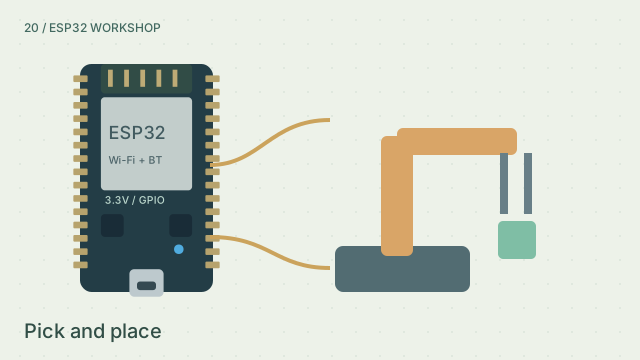
Why it’s here
Choose the destination steps and run a pick, rotate, release cycle.
How it works
Coordinate a stepper base, servo arm and gripper in sequence. 90 degrees. Microstepping and mechanical gearing change the effective steps per turn on real hardware. This guided model targets the original ESP32 and Arduino-ESP32 3.x; radio, acoustics, loads and mechanics are simplified.
Try it
- Open this experiment
- Choose the destination steps and run a pick, rotate, release cycle.
Connections
- GPIO 25 / 26 — STEP / DIR to stepper driver
- GPIO 18 / 19 — Lift / gripper servos
- External supply — Driver and servo power, common GND
Example sketch
#include <ESP32Servo.h>
Servo lift, grip;
// STEP/DIR driver: GPIO25/26. Full-step 200 steps/rev. Set current limit first.

void setup() {
  pinMode(25, OUTPUT); pinMode(26, OUTPUT);
  lift.setPeriodHertz(50); lift.attach(18, 500, 2400);
  grip.setPeriodHertz(50); grip.attach(19, 500, 2400);
}

void loop() {
  grip.write(20); lift.write(30); delay(600);
  grip.write(80); delay(600); lift.write(90); delay(600);
  digitalWrite(26, HIGH);
  for (int i=0; i<50; i++) {
    digitalWrite(25, HIGH); delayMicroseconds(1000);
    digitalWrite(25, LOW); delayMicroseconds(1000);
  }
  lift.write(30); delay(600); grip.write(20); delay(600);
  lift.write(90); delay(600);
  digitalWrite(26, LOW);
  for (int i=0; i<50; i++) {
    digitalWrite(25, HIGH); delayMicroseconds(1000);
    digitalWrite(25, LOW); delayMicroseconds(1000);
  }
}
Check your understanding
How far is 50 steps with 200 steps per turn?
Show the answer
90 degrees. Microstepping and mechanical gearing change the effective steps per turn on real hardware.