RC Circuits & Time Constants (τ = R × C) Explained
Unlike a resistor, a capacitor does not settle instantaneously when you flip a switch. Pairing a resistor with a capacitor creates a predictable exponential curve governed by a single number: the time constant τ = R × C. That simple product powers hardware debounce filters, audio tone controls, and timing delays.
Explore Electronics 101 & its website →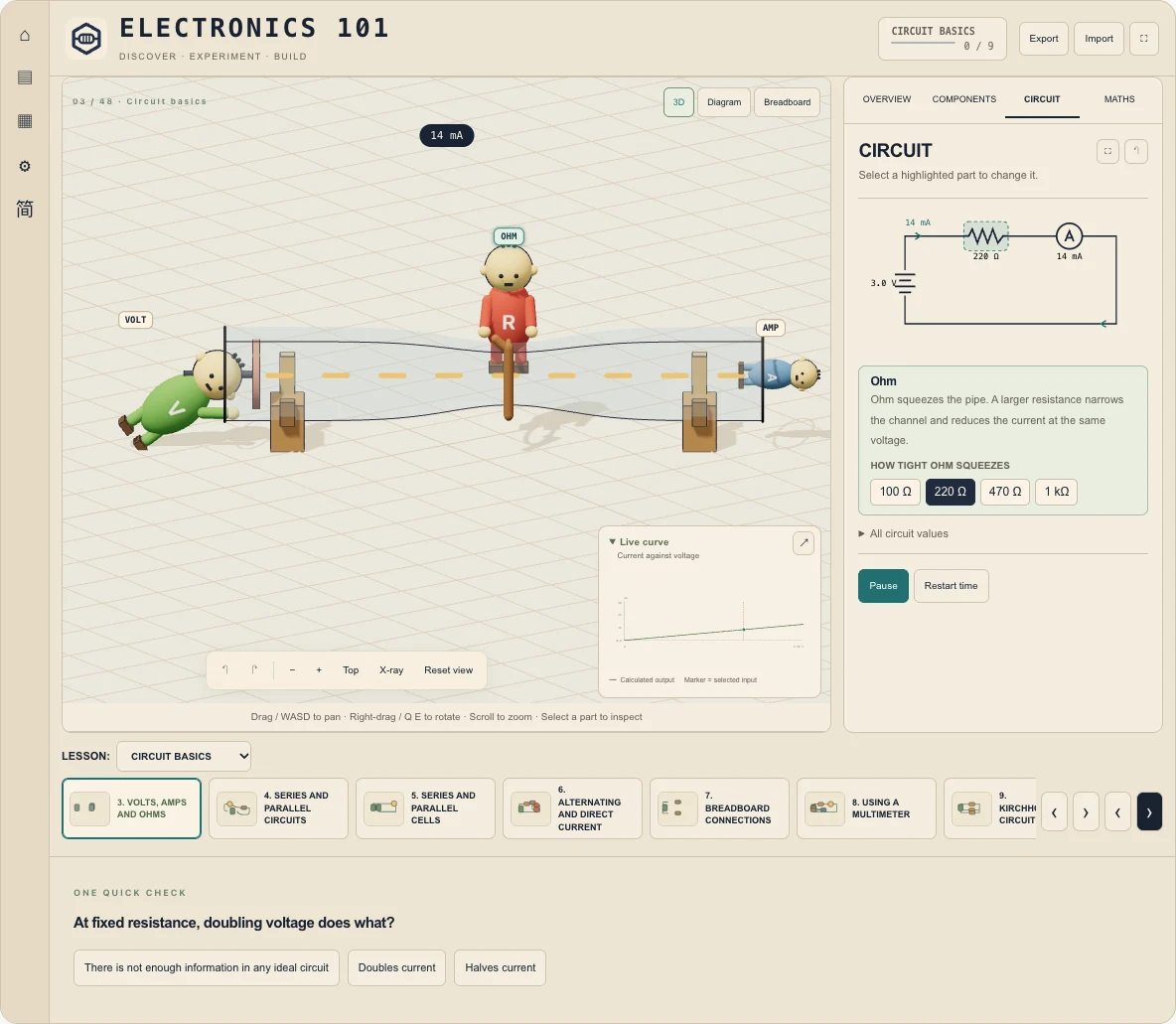
Values follow the standard first-order exponential charging equation V(t) = Vs × (1 − e^(−t/τ)) used in NavSprout’s Electronics 101 capacitor experiments.
The 1τ to 5τ charging milestones
Multiply resistance in ohms by capacitance in farads to get τ in seconds. For example, a 10 kΩ resistor in series with a 100 µF capacitor gives τ = 10,000 × 0.0001 = 1.0 second. Regardless of the supply voltage, the capacitor always reaches the same percentage of final voltage at each multiple of τ.
| Elapsed time | Charging (% of Vs) | Discharging (% of V0) | Practical interpretation |
|---|---|---|---|
| 1 τ | 63.2% | 36.8% | Standard benchmark used to measure τ on a scope |
| 2 τ | 86.5% | 13.5% | Past the steepest part of the curve |
| 3 τ | 95.0% | 5.0% | Within 5% of final steady value |
| 4 τ | 98.2% | 1.8% | Nearly settled for most analog sensors |
| 5 τ | 99.3% | 0.7% | Engineering rule of thumb for “fully charged” |
Why charging current starts high and tapers to zero
At the exact instant you close the switch onto an empty capacitor, the capacitor voltage is 0 V, so the entire supply voltage sits across the series resistor. Initial surge current equals Vs / R. As charge accumulates on the capacitor plates, capacitor voltage rises, leaving less voltage across the resistor and steadily reducing current until it approaches zero.
This explains why a larger resistor slows charging (less current enters the capacitor) and a larger capacitor also slows charging (more charge is needed to raise its voltage by one volt).
Observe the RC curve live in Electronics 101
- Open the Capacitor charging lesson in Electronics 101 and start with the default resistor and capacitor values.
- Watch both the capacitor voltage curve and the current readout—notice that voltage climbs fastest at the start while current peaks at t = 0 and decays.
- Double the resistance and run the curve again: the time to reach 63.2% of supply voltage doubles proportionally.
Common questions
Why do people say a capacitor is “full” at 5τ if the math never reaches 100%?
At 5τ the capacitor is at 99.3% of the supply voltage, which is already closer than the 5%–20% manufacturing tolerance of typical electrolytic capacitors.
How do I calculate τ with kilohms and microfarads quickly?
Kilohms (10³) times microfarads (10⁻⁶) equals milliseconds (10⁻³). So 10 kΩ × 100 µF = 1,000 ms = 1 second.
What is an RC circuit used for besides timing delays?
RC networks act as low-pass or high-pass filters with a cutoff frequency of f_c = 1 / (2πRC), used to debounce mechanical buttons, smooth PWM signals, and block DC offsets in audio.
Sources & editorial method
Written by NavSprout Editorial. Published and checked .
Report a correction →