Ohm’s Law Lab: Change One Variable at a Time
Change one control at a time to see what voltage and resistance do to current. Then use a fourth setup to check whether a higher voltage always produces more current.
Explore Electronics 101 & its website →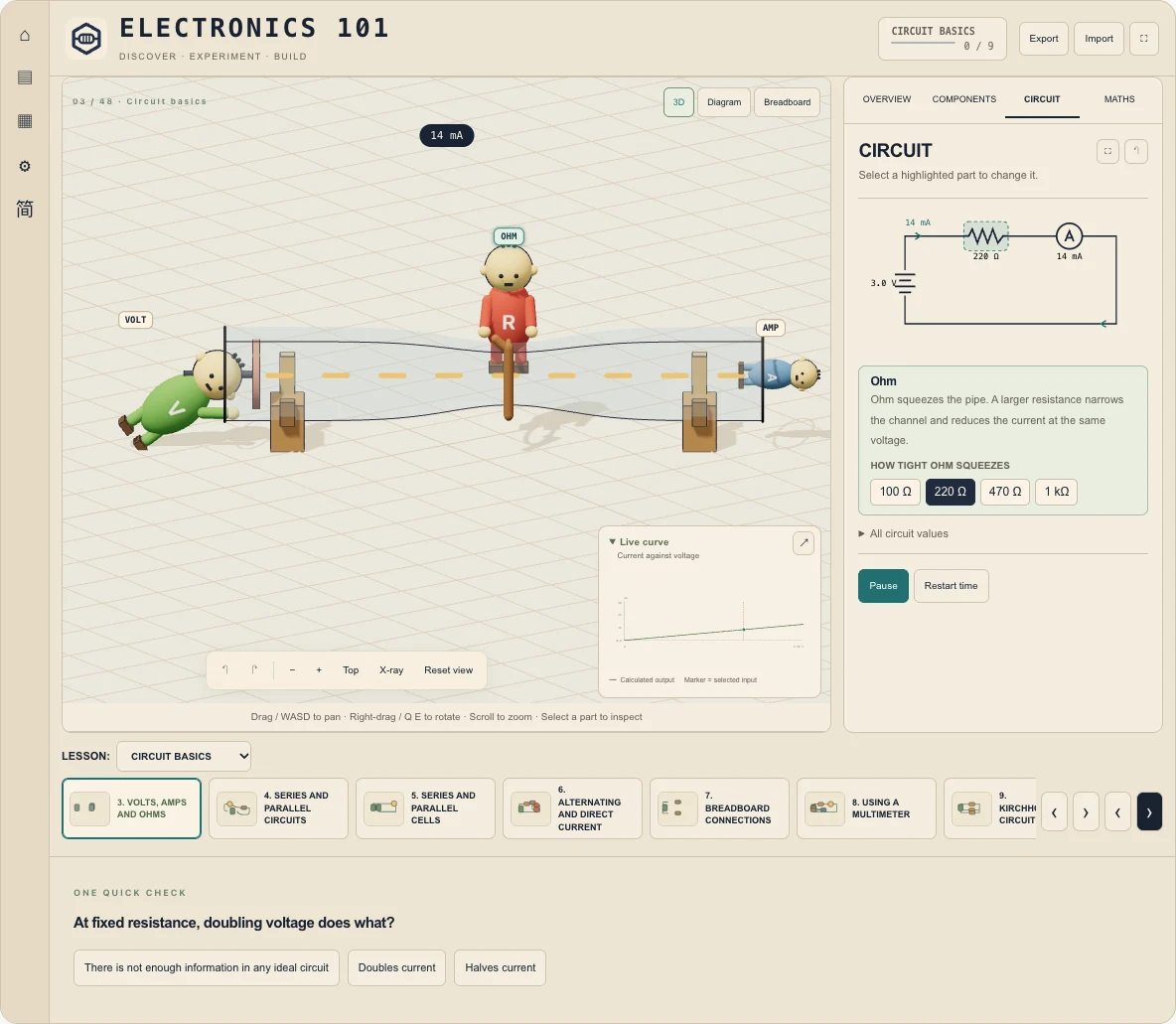
The reference values come from the Electronics 101 circuit model evaluated at the four settings below. The model uses an ideal DC source and a fixed resistor.
Run three trials
- Open the Volts, amps and ohms lesson. Set the source to 1.5 V and resistance to 220 Ω. Write down the current and its unit.
- Choose 3 V and keep 220 Ω selected. Before reading the meter, predict how much the current will change.
- Keep 3 V and switch to 470 Ω. Check how close the new current is to half the previous reading. An exact halving would require 440 Ω.
Compare your readings
Current in amperes is source voltage divided by resistance. Multiply by 1,000 for milliamperes. The power column is calculated from voltage times current, in milliwatts. The meter may round the values differently.
| Source voltage | Resistance | Model current | Model power |
|---|---|---|---|
| 1.5 V | 220 Ω | 6.82 mA | 10.23 mW |
| 3 V | 220 Ω | 13.64 mA | 40.91 mW |
| 3 V | 470 Ω | 6.38 mA | 19.15 mW |
| 4.5 V | 1000 Ω | 4.50 mA | 20.25 mW |
Predict the fourth trial
Before switching to 4.5 V and 1 kΩ, compare the change in the numerator with the change in the denominator. From the 3 V and 470 Ω trial, voltage rises by a factor of 1.5 while resistance rises by a factor of about 2.13. Current therefore falls to 4.5 mA.
Power moves in the other direction for this pair of settings. At 4.5 V the smaller current still dissipates 20.25 mW, versus 19.15 mW at 3 V. Calculate both using P = V × I to see where the difference comes from.
Common questions
Why does doubling voltage quadruple power in the first two trials?
Resistance stays fixed, so the current also doubles. Power is voltage multiplied by current. Doubling both multiplies power by four.
Can I apply these readings to an LED?
An LED has a nonlinear current–voltage curve. Open the LEDs and diodes section in Electronics 101 to see how a forward voltage changes the model.
Sources & editorial method
Written by NavSprout Editorial. Published and checked .
Report a correction →