

Explore Panama earthquake reports and maps on Ojo Panamá, the destination of the former Sismo Panama Vercel app.
WHY HEREFind the relocated site and check the underlying report sources.
Bali Fuel Watch is an independent web prototype for exploring fuel conditions in Bali. NavSprout includes it as a local utility worth evaluating for how it combines a map, anonymous contributions and uncertainty labels. The useful question is not just where a green pin appears, but what evidence that pin represents.
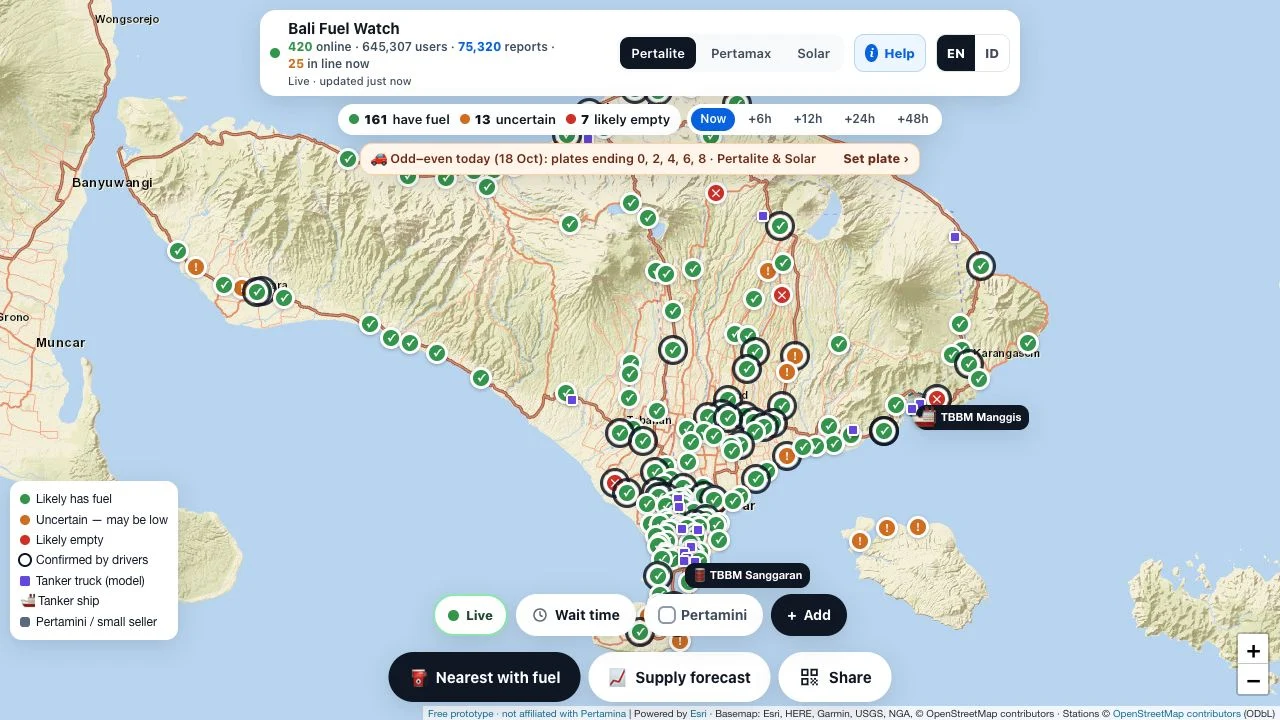
This is a focused local utility where the distinction between mapped places, driver reports and estimates directly affects how a reader should use the result. It fits NavSprout’s task-first approach because one station can be inspected without submitting speculative reports.
Readers evaluating a Bali-specific community fuel map and its uncertainty labels.
Community observations and model estimates can be wrong or stale. No affiliation with Pertamina; no station stock, queue or forecast was independently verified.
Bali Fuel Watch is an independent web prototype for exploring fuel conditions in Bali. NavSprout includes it as a local utility worth evaluating for how it combines a map, anonymous contributions and uncertainty labels. The useful question is not just where a green pin appears, but what evidence that pin represents.
Inspected October 18, 2026: public map, help/disclaimer, visible fuel controls and the EN/ID switch. No driver report, location permission, queue check-in or fuel purchase was submitted. Supply accuracy, waiting-time accuracy and the project’s audience statistics were not independently validated.
The project entry is balifuelwatch.vercel.app. It offers Pertalite, Pertamax and Solar views for Bali, alongside a legend and station details. Public viewing was accessible without signing in or paying when inspected.
Its own description calls it a free prototype independent of Pertamina and government bodies. Treat the page as a community information tool to evaluate, not an official fuel inventory or an assurance that a stop will succeed.
There are at least three questions behind a pin: where the station is, what somebody reported, and what the app estimates. The help attributes location data to OpenStreetMap and explains that anonymous reports and a statistical model inform the changing information.
These layers should not inherit each other’s credibility automatically. A correctly mapped station can have an old report; a fresh user contribution can still be mistaken; a future scenario can differ from what happens at the pump.
The interface includes Now and +6h through +48h views, along with a supply forecast control. They make time an explicit part of the interface, but changing a time horizon does not validate the underlying model.
Before relying on a predicted status, ask whether a forecast error would change your decision. If it could mean a long detour with little fuel left, direct confirmation and a backup plan matter more than an attractive map.
Help describes station reports, queue check-ins and a way to report that a pump has run out. It says a GPS check is used for joining a queue. We read these controls without generating test reports that could mislead other drivers.
Community tools depend on the quality and recency of contributions. A visible report count is not an audit of who contributed, whether the reports are correct or whether all locations receive equal coverage.
The app says reports are anonymous and describes limits on location storage. NavSprout did not inspect its backend or audit retention. Treat those statements as the operator’s account of its behavior and decide whether the requested permission is appropriate to the action.
Do not confuse public access with a complete security assessment. Avoid sharing personal identifiers in station comments and use only observations you can support when contributing.
If the page is unavailable, verify the hostname and connection. If the map shell loads without useful status data, try a reload or another browser and look for freshness information. A failed location lookup may be a permission issue rather than a supply signal.
Do not create speculative reports to test whether the system responds. If current fuel information is essential, move to a station contact or official Pertamina channel rather than inferring availability from a broken interface.
A navigation map answers how to reach a place; a station or operator can answer questions about current service; Bali Fuel Watch adds a community overview. They have different jobs and should be compared on those jobs rather than treated as interchangeable applications.
Ojo Panamá is another NavSprout selection where source reading matters. Its subject is earthquake information, so it is a useful comparison for evidence design rather than a fuel-finding substitute.
https://balifuelwatch.vercel.app/ is the inspected public project entry.
It gives readers a concrete example of a local utility combining place data, community observations and modeled uncertainty.
No. Its disclaimer explicitly describes an independent prototype without that affiliation.
No. We inspected the interface and its explanations without checking a station or submitting reports.
The app has an ID switch, and NavSprout provides an Indonesian version of this evaluation guide.
No. Only contribute a condition you actually observe, so an experiment does not become misleading public information.
Written by NavSprout Editorial. Published and checked . We use primary project pages and distinguish interface observations from features we have not tested. External websites can change after this check.
Independent editorial coverage. NavSprout is not the developer of the apps described here.
Report a correction →Different roles in the same workflow. Follow the reason, then compare.
Explore Panama earthquake reports and maps on Ojo Panamá, the destination of the former Sismo Panama Vercel app.
Compare how another geographic information tool presents sources and limits, for a different subject.