
The Ounza portfolio at rush-morgan-ounza.vercel.app is a personal software-engineering showcase by Rush Ounza. It brings machine-learning experiments, React and Next.js applications, and smaller JavaScript projects into one scrolling website. For NavSprout readers, its value is a concrete starting point: choose one project, understand the problem, then follow the original work rather than collecting another page of app names.
What is the Ounza Vercel app?
Despite the app-shaped address, this is a developer portfolio. The home screen introduces interests in data, machine learning and interactive websites. Projects, About, Activities and Contact are sections of the same page. There is no central AI chat box or hosted model to use here. The projects lead outward to repositories or separate demos, so the useful action depends on which example you choose.
Start with a question, then choose a project
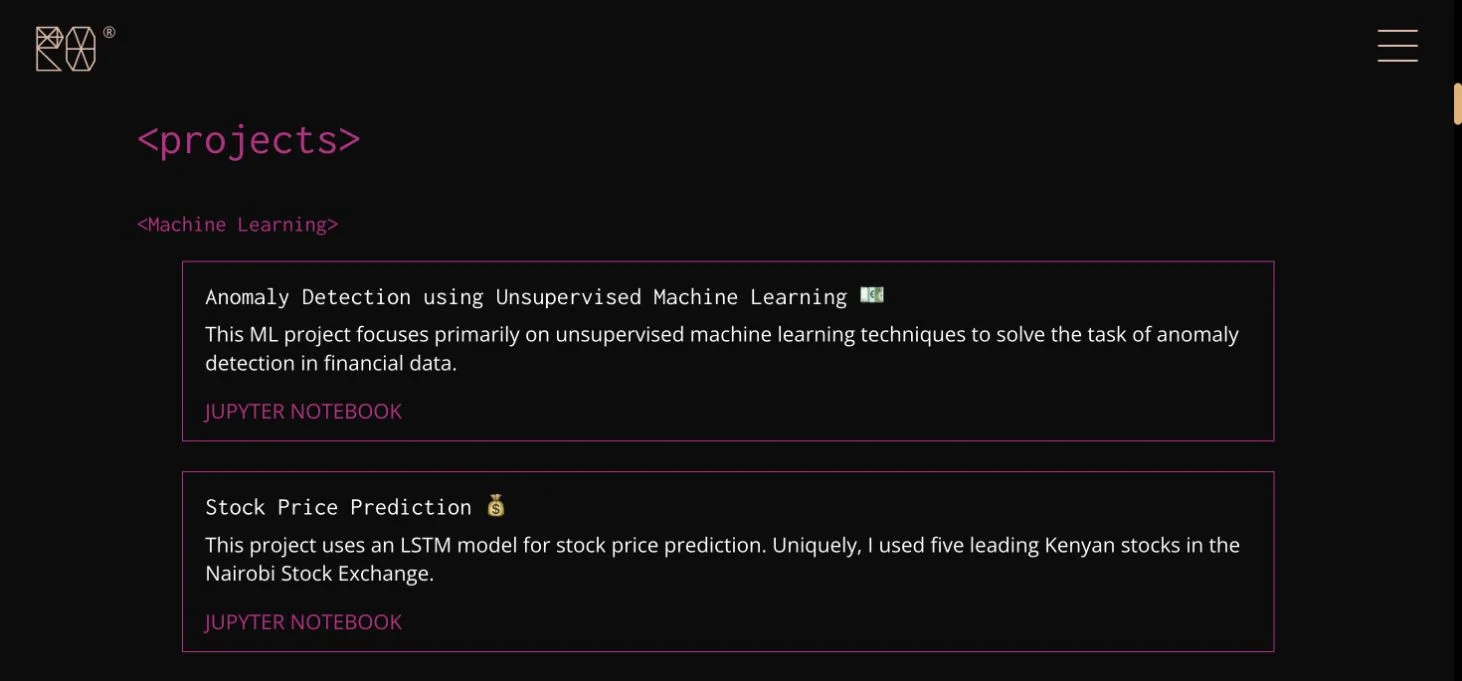
If your question is how to spot unusual financial records, start with the anomaly-detection project in Machine Learning. If you want to understand sequence prediction, look for the LSTM project about five Kenyan stocks. For a more visual example, the CNN card names MNIST, CIFAR and Plant Village datasets. These are descriptions of learning projects; the stock experiment is not a trading service or a promise of prediction accuracy.
Read a notebook with a small checklist
Open the linked repository from the project card and look for the dataset, preprocessing, train/test separation and evaluation method before focusing on a score. Ask what a simple baseline would do and whether another person could repeat the workflow. The portfolio supplies the project direction and a notebook link; those details need checking in the code. We inspected the portfolio interface, not a reproduction of its experiments.
Prefer a web interface? Follow the React section
Coffee Connoisseur describes a coffee-store discovery experience using React, Next.js, Airtable and Foursquare. Lions Clothing is presented as a shopping project with Stripe; House Market Place names Firestore. These give you different interface problems to compare: discovery, product selection and property browsing. A named integration shows the intended stack, not proof that a payment or external API still works today.
What to borrow for your own portfolio
The most useful pattern is grouping work by the kind of problem or technology. A short project explanation followed by a source or demo link helps a visitor move from a claim to an example. Adapt that structure with your own screenshots, outcomes and contribution notes. The animated RO identity and original artwork belong to their creator; this guide is a reference for reading the site, not a template license.
Use the CV and contact routes with context
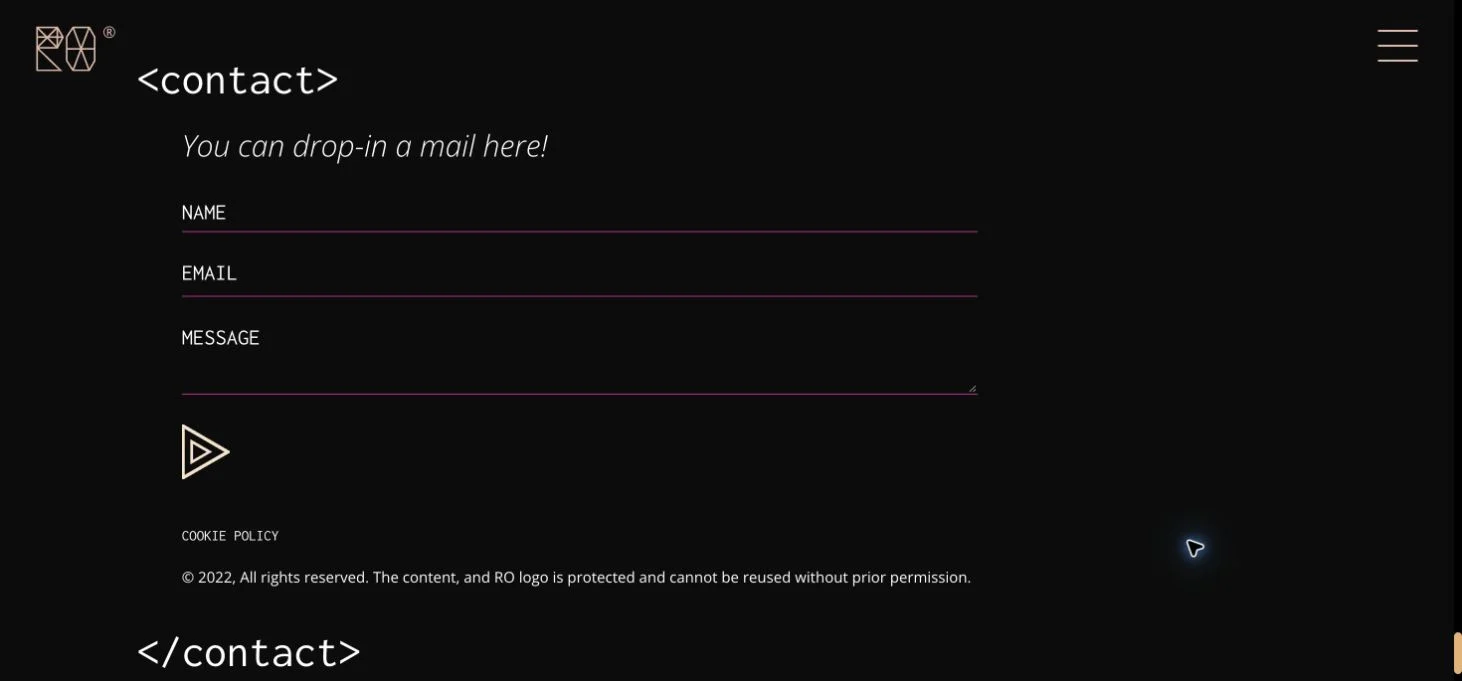
The About section links a button labeled Curriculum Vitae (PDF), but its destination is a Google Docs document. Treat it as an external document link rather than a guaranteed direct PDF download. The site also links GitHub and professional/social profiles and includes a contact form. Refer to the particular project you read when reaching out. We did not submit that form or establish message delivery.
Check status before investing time
The portfolio explicitly marks GEN-Z Africa and R-Pay as Coming Soon and includes a Magic-authentication issue notice on the Netflix Clone card. Other demos may also depend on external services. The visible 2022 footer does not establish when each project was last maintained. Use the live destination and repository history to decide whether a project is an active example or a historical study.
Inside the original Ounza portfolio
These are real captures of the reviewed website, not concept illustrations. Open an image to inspect the original viewport.
A focused first visit
- Open the official portfolio and go to Projects.
- Choose one problem: anomaly detection, a React interface or a JavaScript game.
- Read the project description, then follow its own repository or demo link.
- Write down the input, expected result and one limitation before comparing another project.
Ounza portfolio FAQ
Who is Rush Ounza?
Rush Ounza is the name used by this portfolio and its linked GitHub and social profiles. The site presents work in machine learning and web development. Its biography is self-described, not an independently verified current employment record.
Is Ounza an AI tool?
The supplied Ounza Vercel URL is a personal portfolio. It showcases machine-learning projects but does not provide a general-purpose AI assistant.
Where should a beginner start?
Choose one clearly described project and follow its source link. The anomaly-detection card provides a specific problem to investigate; JavaScript games offer a different route for readers interested in browser interactions.
Does it include React and Next.js projects?
Yes. A dedicated category includes Coffee Connoisseur, Lions Clothing, House Market Place, a Netflix Clone and a Feedback App. Each card describes its intended purpose and stack.
Is the CV a downloadable PDF?
The button says Curriculum Vitae (PDF), but the observed link points to Google Docs. Document access and a direct PDF download were not verified.
Do all Ounza project demos work?
This review does not establish that. Some cards are marked Coming Soon, and the Netflix Clone includes an authentication issue notice. Check individual destinations before relying on them.
Can I reuse the portfolio’s logo and design assets?
Viewing the portfolio does not grant an asset license. Its footer reserves rights in the content and RO logo. Use your own work when building a portfolio.
Sources & editorial method
We inspected the original Rush Ounza portfolio, its rendered project cards, navigation, CV destination and contact interface on October 27, 2026. The A2A Protocol portfolio guide supplied background context; descriptions here were checked against the original site. The official RO mark comes from that site’s own SVG logo, with its original geometry and styling.
Original project destinations include the anomaly-detection repository and Nairobi stock-prediction repository. Their contents, results and licenses require their own review. We did not reproduce model experiments, test every demo, verify credentials, access the CV document or submit the contact form.
See our editorial approach, return to the blog, or browse web tools for a task-oriented discovery.